The database resulting from more than thirty years of activity, integrated with data acquired using other geophysical methods, is the essential tool for investigating and providing answers to many of the questions
posed by the study of the lithospheric characteristics and tectonic processes taking place in this area. For a long time scholars have been aware that seismology can make a fundamental contribution to improving our
knowledge of the evolution of the Antarctic continent. Nevertheless, detailed seismological studies in Antarctica were difficult until the beginning of the last decade of the last century, when technological progress
made available to researchers instruments capable of providing high quality recordings over the entire frequency and amplitude spectrum characteristic of seismic phenomena and suitable for prolonged use in extreme
environmental conditions.
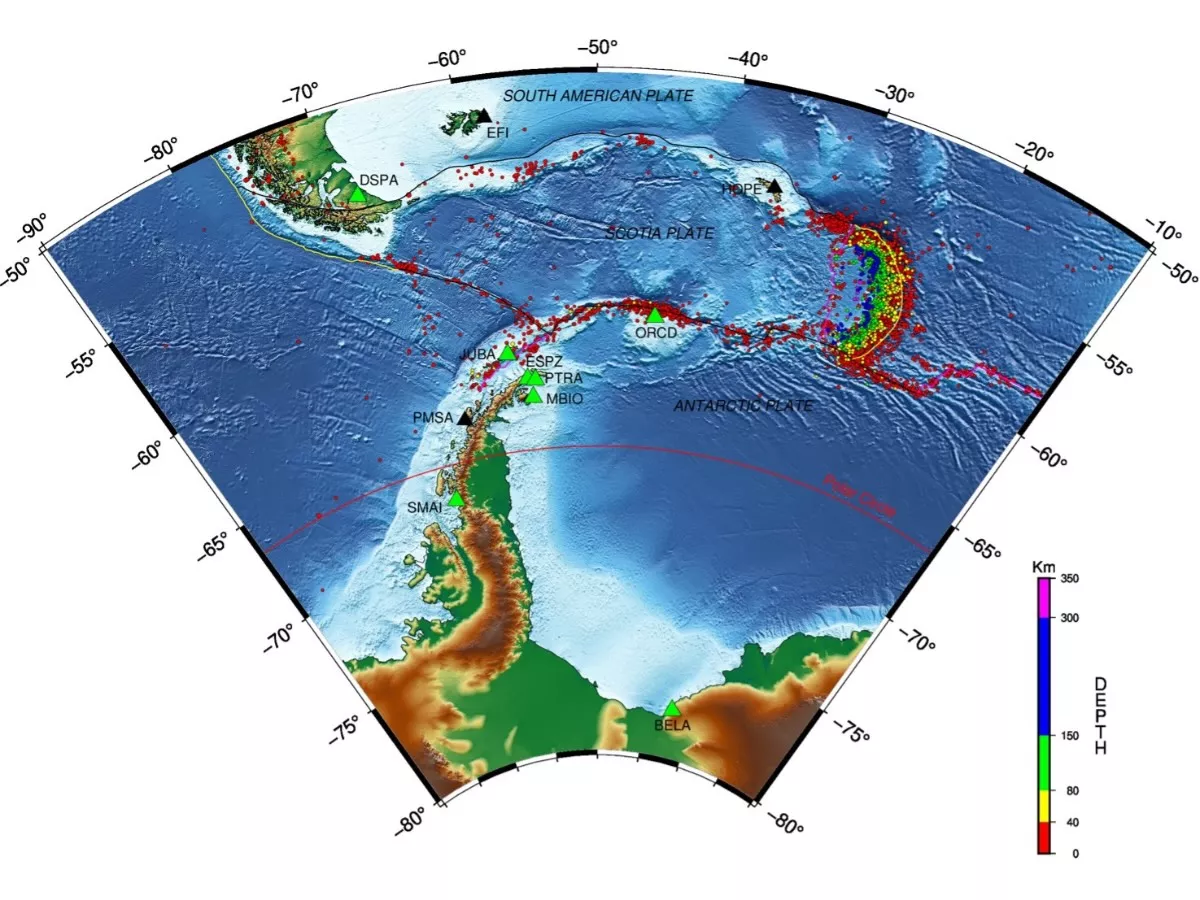
At that time, the Antarctic programmes of many countries began to focus their efforts on the development of an Antarctic seismographic network, which currently has a few dozen station points
useful for improving the detection threshold of seismicity in the Southern Hemisphere. Since the early 1990s (1992), when the basic seismographic station Esperanza was activated by OGS and DNA-IAA, PNRA has widely
recognised the essential role of modern seismology for monitoring and studying the physics of the seismic sources that characterise the Scotia Sea and surrounding areas, and the importance of installing a network
of permanent seismological observatories to monitor the area with the aim of providing the scientific community with a database of data of adequate quality to meet the needs of the studies being developed. Since
then, PNRA has continuously financed the development and management of the Italo-Argentine Antarctic Seismographic Network (ASAIN) today comprising 8 permanent seismometric stations, 7 of which operate at the
Argentine Antarctic bases Esperanza (ESPZ), Carlini ex Jubany (JUBA), Orcadas (ORCD), Marambio (MBIO), San Martin (SMAI), Belgrano II (BELA), Petrel (PTRA) and 1 in Tierra del Fuego at Despedida Farm (DSPA).
Each of them, all carried out by the OGS on the basis of multi-year official agreements with the DNA-IAA and collaborations with other Argentinean scientific institutions regarding the stations in Tierra del
Fuego, constitutes a “permanent observatory”. They are in fact structures that carry out continuous activities of collecting observations and seismological data of general, national and international interest,
standardised according to the specifications of the international seismological centres in charge, using seismometers that they acquire, archive locally and retransmit in real time via Internet and satellite to
the OGS, IAA, to the European international centres ORFEUS and to the US organisation IRIS (International Research Institutions for Seismology) the recorded waveforms that guarantee public access according to
standardised and free of charge procedures using the relevant international formats for digital seismological data. In addition to the normal activities of maintenance, station management in Antarctica, archiving
and distribution of Network data, the previous five years were characterised by the further refinement of the Network through the construction of a new station. Priority was given to the ASAIN's flagship observatory
commissioned on an experimental basis in 2009 at Base Belgrano II at the south-eastern end of the Weddell Sea, the southernmost of the permanent stations operated by the DNA-IAA is located on a granitic outcrop
emerging from the Filchner barrier completely surrounded by ice from the polar ice cap just 1350 km from the south pole. The station was completed in 2012 when a CMG-3TD Polar model seismograph replaced the CMG-ESPCD
operating since 2009. The latter was put into operation during the 2013-2014 campaign in the observatory built the following year at Base Marambio. In addition to the standard processing for localising the seismicity
of the area, the data recorded over the last twenty-five years are also used to discriminate and document seismic events that can be correlated to sudden changes in the ice of the Antarctic continent.